

Feature image: Anne Labovitz in the studio. Photo: Bailey Bolton.
By Frank Juárez
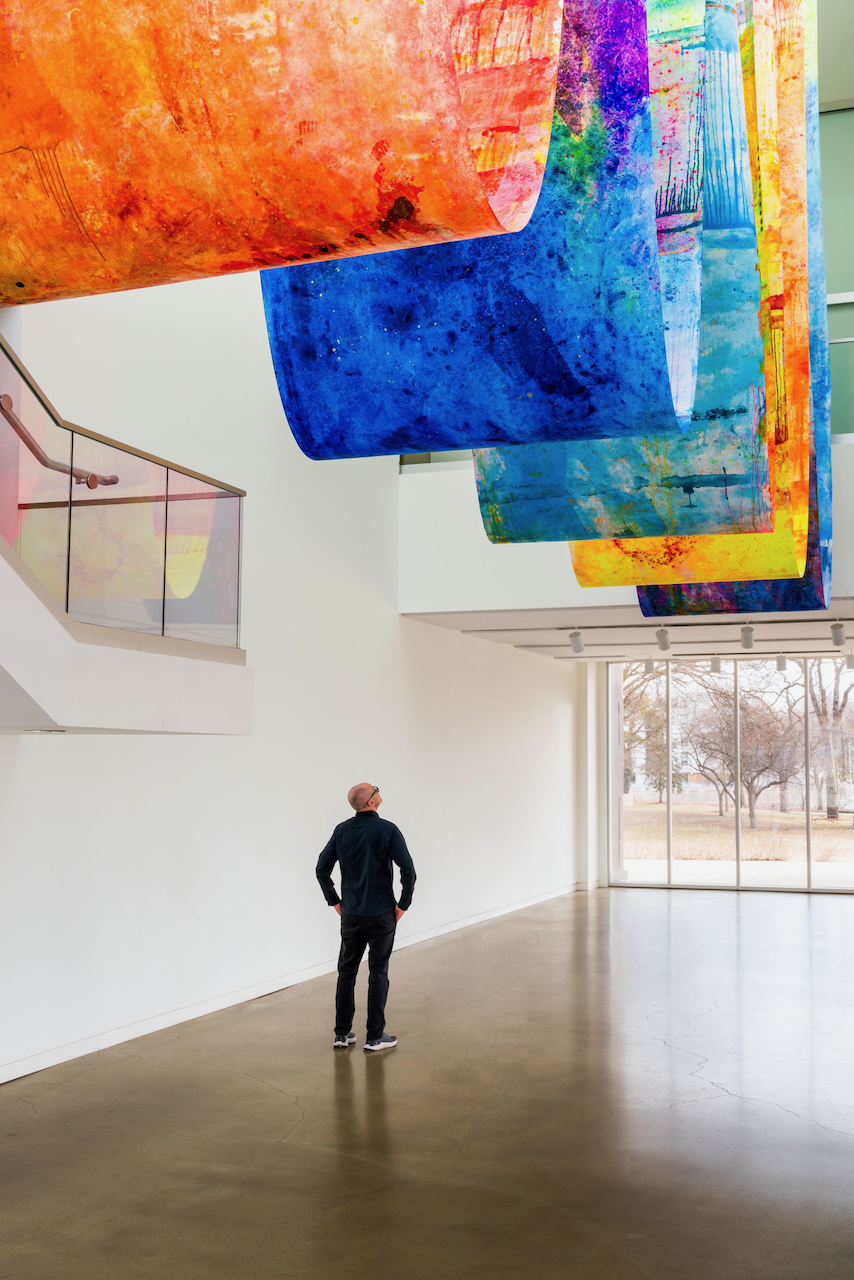
I saw the work of Anne Labovitz at the Rochester Art Center, Rochester, Minnesota, in 2023. The exhibition was titled “The Nexus of Well-Being and Art.” The exhibition consisted of an atrium installation, “Will To Meaning,” which greeted me as I entered the art center. I remember being mesmerized by the scale, repetition of draped material installed from the ceiling, and vibrant colors. It had such a presence that it set the tone of my visit. On my way to the main exhibition space, I felt eager to see what was next.
I began thinking of the context of the exhibition and what it meant to take care of ourselves and others. What does this look like in our practice, work, and home environments? 2023 was a year in which mental health was the top priority for everyone. I have felt the anxiety, stress, and never-ending feeling of not knowing when we will go back to how things were.

I sat down with Labovitz virtually to learn more about her process, practice, and work ethic. After reconnecting for a few minutes, we dove right into the conversation, which focused on two main questions: What informs your practice, and in what ways do you use your studio practice to bring light to important topics such as mental health, well-being, equity, and community?
“Art is a gateway that welcomes everyone…to connect to something bigger than ourselves.” – Anne Labovitz
Labovitz states that her work is centered on how we are human together, the people, and the human condition. Through art, we can find ways to connect regardless of socioeconomics, race, sexual orientation, culture, and so on. Art is a gateway that welcomes everyone to have a shared art experience about what it means to connect to something bigger than ourselves. Creating space for us to come together is an integral part of Labovitz’s work. A space that allows for self-reflection, to be seen through a communal lens, and to pause life – even for a moment. People need to connect to the context of her work. Providing the community access to contribute to the conversation by amplifying their voices to be heard is important to the quality and equity of the art experience.

Labovitz’s work is contemplative, relevant, and impactful in many ways. Using art as a vehicle to bring attention to important personal and societal issues and concerns is one of the best ways to begin that engagement and process healing. Through her research-based practice, ideas are investigated, influence creative decisions. These creative decisions include voices and personal perspectives from the community. “People’s words are my reason, “says Labovitz. Through an inclusive approach, her attention to detail, personal inquiry, artistic vision, and the art of listening provide a roadmap that addresses her wondering on how she can continue to have the impact that brings people together.
When you are fully committed to your practice, it encompasses your entire being and becomes what you are about as an artist and human. A passion driven by purpose.

lights and Plexiglass, 10 x 136 x 1 feet (currently on view) Photo: Bailey Bolton.
To learn about Anne Labovitz, visit labovitz.com and connect on Instagram at @annelabovitz.
Frank Juárez is an award-winning art educator, curator, and arts advocate based in Sheboygan, Wisconsin. Known for his commitment to elevating contemporary art and supporting Wisconsin artists, Juárez has spearheaded numerous initiatives, including the Midwest Artist Studios Project and the 365 Artists 365 Days Project. In addition to his roles as publisher of Artdose magazine and editor-in-chief of SchoolArts magazine, Juárez has curated exhibitions and juried art shows throughout the Midwest. His dedication to art education and advocacy has earned him numerous accolades, making him a pivotal figure in Wisconsin’s art community.