

Artdose is pleased to announce its 10 artists to watch in 2026. Artists are Bryana Bibbs, Geornica Daniels, Melissa Scherrer Paré, Brandom Terres-Sanchez, Lillian Supanich, Kaden Van De Loo, Kushala Vora, Michael Ware, Cassandra Xiong, and Carina Yepez.
10 artists to watch in 2026 was curated by the Artdose team.
Bryana Bibbs

Bryana Bibbs is an artist and educator based in Chicago, working at the intersections of textiles, painting, and community-based practices. Her work explores themes of mental health, the fragility of memory, and personal experiences. Bibbs documents these themes through printmaking, photography, and weaving. Bibbs holds a Bachelor of Fine Arts with an emphasis in Fiber and Material Studies from The School of the Art Institute of Chicago.
Photo: Tonal Simmons

Photo by Ben Wheeler, courtesy of the Lunder Institute for American Art.
My work is an archive of lived experiences related to trauma, grief, loss, and mental health. Sharing these stories can be challenging due to societal stigmas, and this challenge has become a central motivation in my practice. Navigating these experiences through weaving and materiality provides me with the relaxation and patience to explore and understand them.
In my recent work with pressure printing and weaving, I incorporate everyday objects and materials that belonged to my grandparents. I also reference architectural elements from their home that are connected to my childhood memories, my experiences caregiving for them in their 80s, and their passing in 2023 and 2024.


Geornica Daniels

Geornica Daniels is a sculptor and installation artist based in Wisconsin. She is an MFA candidate and in Sculpture at the University of Wisconsin–Milwaukee, and holds a BFA from the Milwaukee Institute of Art and Design. Her work has been exhibited throughout the Midwest and nationally, including at the John Michael Kohler Arts Center, Rahr-West Art Museum, Wright Museum of Art, Women Made Gallery, ARC Gallery, and Walker’s Point Center for the Arts, where she will present an upcoming solo exhibition.
Photo: Alayna Pernell
Daniels’ practice focuses on sculptural vessels to explore memory, restraint, and unrealized potential. She uses materials including paper, rope, beeswax, zip ties, and found objects. Through repeated processes of accumulation and constraint, her forms exist between the bodily and the architectural, defined as much by their potential capacity as by their limitations.
Recently, Daniels’ work has focused on the limitations of archives, especially their omissions, distortions, or erasures of Black life and experience. Instead of seeking recovery or resolution, her practice engages with these absences, treating incompleteness as a space for creation and critical fabulation.
Daniels has received the ACRE Residency, the Cedarburg Cultural Center Residency, and a graduate fellowship at the University of Wisconsin–Milwaukee. Beyond exhibition and production, she views her work as a responsibility to support cultural memory where it has been diminished or withheld, and to model a sustained, serious artistic practice for future generations of Black artists. Her practice aims to demonstrate that this work is both possible and necessary.

My work centers on sculptural vessels as a means of exploring memory, restraint, and unrealized potential. I am interested in the consequences of withholding or containing, in moments when growth is delayed, interrupted, or never fully realized, and in how these conditions inform my sculptures over time. The vessel recurs in my practice not only as a container, but as a structure defined by tension and the understanding that it can never fully hold.
I work with materials such as paper, rope, beeswax, zip ties, floral foam, and found objects because their physical properties reflect these conceptual concerns. Many of these materials undergo transformation, shifting from wet to hard, pliable to rigid, unbound to constrained, or solid to melted. My process is iterative, relying on repetition and accumulation. These materials may sag, soften, or resist control, revealing their limitations even as they are tasked with containment.
Through sculpture, I engage with absence, vulnerability, and the enduring weight of what remains unresolved.

Grouping of work, rope, zip ties, variable dimensions. Photo: Alex Witteman.

Let Go or Be Dragged, Paper, barn beam, fishing line, 53 x 16 x 24 in.
Melissa Scherrer Paré

Melissa Scherrer Paré works across several mediums, including silk painting, paper pulp sculpture, and photography. Exhibitions include a 2025 solo exhibition with Museum of Wisconsin Art, 65 Grand (Chicago, IL), Pacific Northwest Fiber Arts Museum (La Conner, WA), Villa Terrace Art Museum (Milwaukee, WI), Regina Rex (Brooklyn, NY), Lisa Cooley Gallery (New York, NY), Proof Gallery, (Boston, MA), and Ukrainian Museum of Modern Art (Chicago, IL). Reviews and features include The Boston Globe, New City, M Magazine, and Milwaukee Journal Sentinel. She received her BFA University of Wisconsin – Milwaukee and her MFA from the University of Illinois Chicago.

My work uses the detritus of domestic life to create beauty out of the mundane. Discarded paper, credit card statements, medical records, receipts, and my daughter’s schoolwork are transformed into pulp and shaped over upcycled household objects, elevating the overlooked into sculptural form. Inspired by Wisconsin nature and familiar domestic textiles, my silk paintings embrace intuitive linework and imperfection, allowing new patterns to emerge from disrupted order. The imperfections begin to form their own patterns, building a visual arrangement of their own.


Brandom Terres-Sanchez

Brandom Terres-Sanchez (He/They) is a Mexican American artist originally from Las Vegas, Nevada, and now based in Milwaukee, Wisconsin. Recent graduate from Milwaukee Institute of Art & Design with a BFA in New Studio Practice. Their paintings are paired with audio, found objects, and writing to create an immersive experience that encapsulates “Home.” His work allows the viewer to feel a personal connection to home while also experiencing the distance between us, home, and the artist. His work has become a cozy reality, one that we crave. Their work has been shown in spaces like Var Gallery, Rahr West Museum, and the Trout Museum of Art. His body of work becomes physical manifestations of memory of his former home, immersive, visceral, rendered, and replicated, all descriptors that live deeply familiar yet profoundly estranged throughout their work.
Photo: Ellie Garry

My oil paintings are an uncanny visual representation of home, with the addition of audio, found objects, and writing that directly reference my home. My work comes from longing and yearning, tied to memories of home. Home is universal, whether good or bad, and my practice connects to the feelings we hold around it. I hope the work can be a way for people to process their own emotions about the complicated word “home” and find relief in knowing we all feel homesick at times.
The exterior of my home and its rigid features are forms of protection that often hold memories themselves. The loss of place and memory are seen in the incomplete renderings of bodies, the rust and the layering of paper. My home is still actively creating memories even if I am not physically there. Life continues even if you are not present and with that the home grows without you.
The additional elements in my work are made with the idea of limitation and protection. By restricting what the viewer sees, I mirror the way a home conceals. I often find myself viewing my own home from outside, almost as a trespasser to the place I once knew.
My practice reflects on the universal yet complicated meaning of “home.” It is a space tied to comfort, loss, protection, and memory. Through my work, I attempt to revitalize fragments of the home I once knew — recreating moments that once gave me comfort but now carry the weight of absence. The viewer is invited to sit with this tension, to feel both presence and absence, and to reflect on their own layered relationship to the idea of home.


Lillian Supanich

Lillian Supanich earned her BFA at MIAD before beginning a career in fabrication. She approaches her work with interdisciplinary concerns, which revolve around painting and taxidermy. Her work has been exhibited at Some Fools Gallery, the Charles Allis Museum, and One-Off Exhibitions in Milwaukee. She’s appeared on Riverwest Radio and in queer zines around both Madison and Milwaukee.
Photo courtesy of the artist.

As distinctions blur and groupings fail, abjection bleeds into us.
It’s from this place, where we lose ourselves, that I like to paint. My recent work responds to a professional history with taxidermy, where I learned that assembly is made possible only by first breaking things down. The fractured subjects I paint are likewise not simply given, but the end result of such fragmentation. I’m committed to an illusionistic rigor, where methods of breakdown are typically concealed, but for me, they re-enter the frame as thematic content where they embody their own making.
First impressions that see abstract are likewise challenged by subtleties in form that reveal my observational process. Abstract passages and disciplined figuration readily swap places. Misrecognition of this kind, and misrecognition of the subject perform a failure to remain fixed, unmasking the processes of viewing and interpretation as inventive.
The shapes and subjects I make are pieced together and sit with their indeterminacy, where seams still show and rigid representation slips. An allegory for the fractured subject shows through these cracks.
I relate to embodiment through my queerness and transition. In my work, identity formation gets called into question wherever suggestions of the figure appear, from the figurative subject to my own mark-making. In the same way that my paint is layered to generate new, reflected colors, the subject bears itself through a layering process. False faces lay over one another, grafting their meanings on top of one another.
At seams where surface and illusion meet, I can indulge in the lushness and ambivalence that is so rich in painting.


Kaden Van De Loo

Kaden Van De Loo is a painter based in Milwaukee, where he received a BFA in Painting and Drawing from UW-Milwaukee in 2024. He has had solo exhibitions at Portrait Society Gallery and the University of Wisconsin-Oshkosh. Other venues to show his work include the Trout Museum of Art, Var Gallery, the Milwaukee Institute of Art and Design, and Greenpoint Open Studios in Brooklyn, New York. Van De Loo was a member of Plum Blossom Initiative’s Bridge Work 10 professional development program in 2024-25. He showed work with Real Tinsel in the Atlanta Art Fair in 2024 and was published in the 2025 Midwest edition of New American Paintings.
Photo courtesy of the artist.

In each of my paintings, a minimal grouping of forms is situated within a field of bands of atmospheric color. Emerging out of or disappearing into the field, the gestaltic formations—like impossible celestial systems, strange microscopic or atomic structures, poised athletic positionings, military insignias, light-studded aircraft, or budding botanical entities—are near-symmetrical and centrally located. Then, bands of color construct, define, and energize the space and the formation. These bands may make up atmospheric expanses or patterned grounds, appear like piercing beams of light, or function as graphic stripes. The ensuing interplay between the bands and the emblem-like formations places the paintings in conversation with formats of visual identity like flags, heraldry, sports team branding, and fashion, but their reliance on atmosphere and luminance means they possess an intimate, ghostly presence.


Kushala Vora

Kushala Vora is a visual artist and organizer working in sculpture, drawing, and installation. Through her practice, she focuses on loosening the exertion of power on oneself, others, and the landscape with which we coexist.
Photo: Mark Blanchard
Kushala was awarded the 2024 Jyotsna Bhatt Ceramics Award and was named one of 2023’s Breakout Artists by Newcity Magazine. She has been an artist-in-residence at Skowhegan School of Painting and Drawing, Yingge Ceramics Museum (Taiwan), Hyde Park Art Center, Anderson Ranch Art Center, Shillim Institute (India), Søndre Green Farm (Norway), and ACRE Residency. Her work has been exhibited at the American Museum of Ceramic Art (Sonoma, CA), Indian Ceramics Triennale 2024 (New Delhi, India), Bikaner House (New Delhi, India), Engage Projects (Chicago, IL), Goodman Theatre (Chicago, IL), Museum of Fine Arts (Nagoya, Japan), Harvard University (Cambridge, MA), among others. She received her MFA from The School of the Art Institute of Chicago. She holds a postgraduate diploma in Modern and Contemporary Indian Art History and Curatorial Studies from Dr. Bhau Daji Lad Museum in Mumbai, India, and a BFA from Tufts University/SMFA, Boston. She is the co-founder of Atmo—a reading and praxis forum—and is an active contributor to Spaceshift Collective.

While navigating a ‘post-colonial’ world with enduring power structures, my work focuses on loosening the exertion of power on oneself, others, and the landscape with which we coexist. I do this by untangling the ways in which we learn the parasitic roots of power through formal and societal education. By working with clay, minerals, wood, paper, rust and found objects as active collaborators, I experiment with unlearning calcified habits. I challenge perception shaped by classification, recalling visual markers of power to disrupt ingrained habits – like thinking within the ruled increments of my childhood notebooks, a structure echoing control. I hope that my work will pave a path for reconciliation with our histories and a renewed relationship with how we treat each other and the environment we occupy.


Installation view of Experiments in Practice : Ela Mukherjee and Kushala Vora supported by the Jyotsna Bhatt Ceramics Award 2024 at Ark Foundation for the Arts, Vadodara. Photo: Dhaivat Shah.

Installation view of Experiments in Practice : Ela Mukherjee and Kushala Vora supported by the Jyotsna Bhatt Ceramics Award 2024 at Ark Foundation for the Arts, Vadodara. Photo: Dhaivat Shah.
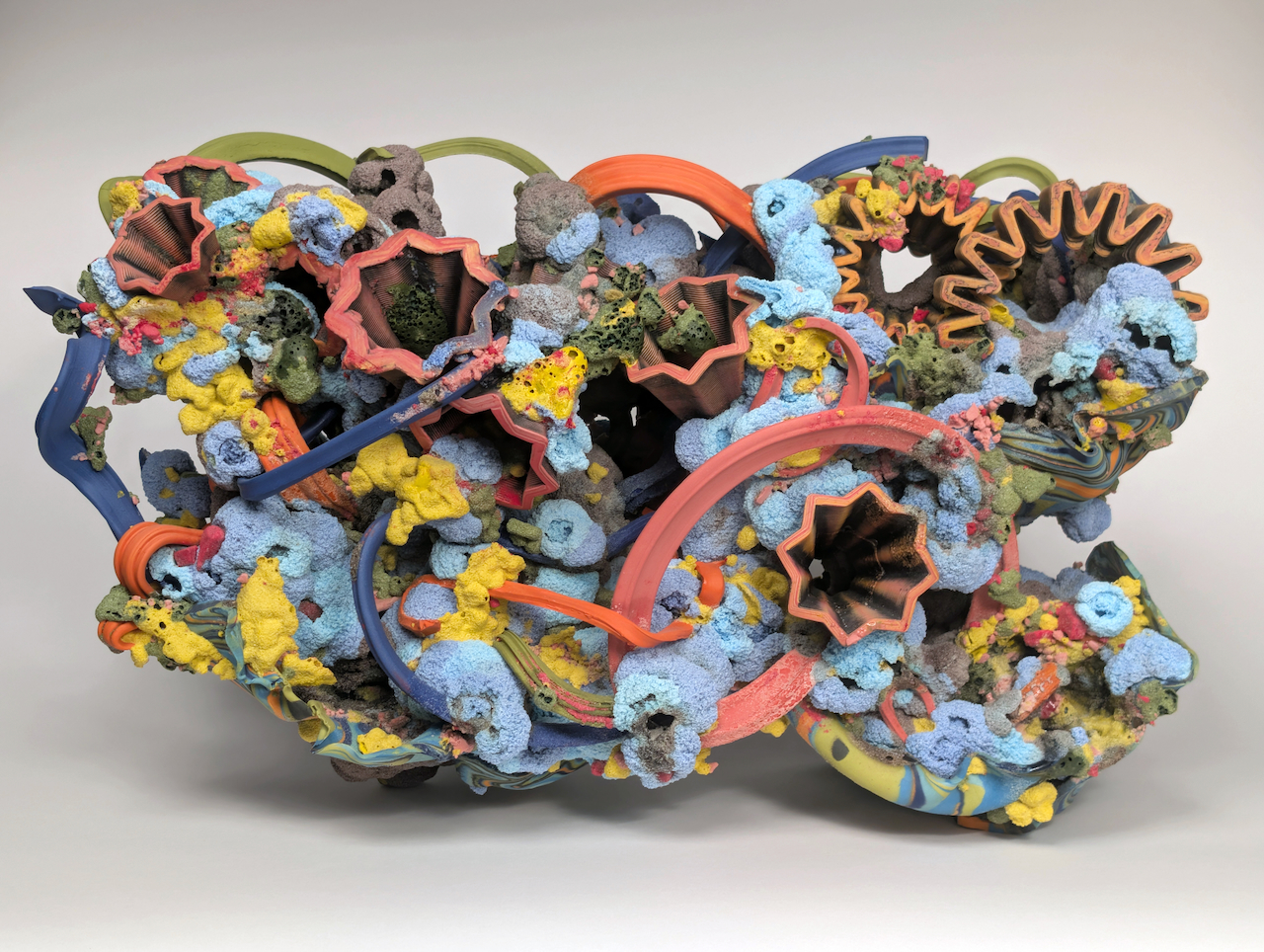
Michael Ware

Michael Ware was born in Montpelier, Vermont, and has lived in many different regions of the United States throughout his life. He earned his Master of Fine Arts from the University of Wisconsin – Milwaukee in 2015. Before that, he traveled extensively throughout North America. Those travels are the inspiration for his abstract sculptures that reference both the landscapes and the geological forces that created them. Michael has shown his work both regionally and nationally. His work is in many collections throughout the country, including the Rhode Island School of Art and Bradley University.
Photo: Adam Miszewski

During a trip to the East Coast, I had a sublime experience in the Adirondack Park in Upstate New York. I was overwhelmed by a powerful presence of beauty. Walking through the woods the earth felt alive. The terrain is relatively untouched and has an intangible energy flowing through it. The landscape had the power to draw me in with both its vastness, and little details. I was presented with an infinite number of worlds within a larger one. The trip caused me to consider how the landscape originated, not just what it looked like. Unlike the landscape, which can appear permanent and fixed, the tremendous forces behind its creation are full of energy and life. What if that spirit morphed into geologic amalgamations of ceramic objects?
Layers is a collection of recent ceramic sculptures that reimagine the colorful strata within the earth. This layered information is an archive of forces and events. My sculptures are an accumulation of smaller elements. These individual elements are visual abstractions inspired from all senses, not just sight. For instance, the warmth of a ray of sunshine, the punch of a tart libation, the funky tones of a clavinet or the sweet aroma of a flower. The elements are layered with vibrant ceramic materials. Fused together to create multifaceted compositions with new relationships and visual paths. I encourage you to explore the layers. Where lines become movement and vessels become passageways.


Cassandra Xiong

Cassandra Xiong is from the Hmong diaspora displaced to Wausau, Wisconsin. She received her Bachelor’s Degree in Sociology from the University of Wisconsin-Stevens Point. Her work centers on fostering collective healing and liberation through creative arts. She was a changemaker in the SEAD Project’s SEA Change Lab fellowship in 2024, designed the play poster for “SIXPACK” written by Katie Ka Vang in 2025, and has published poetry in the anthology “The Survivors” (2024) and the “Stevens Point Community Poets Showcase” chapbook (2025). She has facilitated art and healing workshops at the Racial Justice Summit, the Coalition of Asian American Leaders, and Theater Mu. Cassandra finds healing through writing poetry, making zines and collages, and attending the Second Tuesdays Poetry Open Mic in Stevens Point.
Photo: Boly Vang

I am a collagist, poet, zine maker, and activist whose artistic practice centers around creating opportunities to experience healing and liberation, and using creativity as an intentional act of resistance. I create to process my lived experience as a person of the Hmong diaspora displaced to the United States, and to empower others to imagine a world beyond the systems we live in. My work challenges the covert discouragement of creativity from our social systems by embodying creativity as a natural and necessary part of the human experience.
This chapter of my artistic journey was born out of my need for healthy, expressive, and creative healing practices. I began with writing poetry, which fulfilled my need to process emotions. Then I found collaging, which fulfilled my need for a hands-on creation process. Soon after, I combined poetry and collages to create zines. My journey has now developed into an act of creating social change through workshop facilitation. Rather than teaching an instructional workshop, my workshop offers collaging while engaging in a guided discussion about the philosophical lessons that art teaches us about life, and how the application of these lessons fosters healing and liberation. I am most inspired by collage because of how it reflects our world. All the pieces are assorted, diverse, seemingly unfitting yet complementary, and ultimately come together as a whole to create a unique and beautiful image that is reflective of all its parts. I hope my work allows others to learn about themselves and the world through the act of creation, and to see the value of creating as a healing and liberatory practice.


Carina Yepez

Carina Yepez is a fiber and material-based artist whose work centers on cultural memory, community, and the transformative potential of craft. She earned her MFA from the School of the Art Institute of Chicago and works at the intersection of arts education and socially engaged practice as a Program Specialist at Firebird Community Arts and an Adjunct Professor at SAIC. Yepez has exhibited at the Art Institute of Chicago, the Dom Museum Wien in Vienna, Austria, and the National Museum of Mexican Art, among other venues.
Photo courtesy of the artist.

Carina Yepez is a Chicago-based artist and educator with family roots in Guanajuato, Mexico. Her work weaves together matriarchal traditions and the stories of immigrant communities through quilting, sewing, and photographic weaving. Transforming domestic techniques into a language of memory and resilience, she explores ancestral healing and cultural lineage. Floral motifs drawn from her heritage recur throughout her pieces, bridging craft and fine art while creating spaces for reflection, connection, and dialogue.


Artdose is always looking for artists to feature. Amplifying artists is important to us. We provide opportunities for engagement, connection, and [art] community through various initiatives. Follow us on Instagram at @artdosemagazineweekly.
Artdose magazine weekly art newsletter