

Feature image: Debra Yepa-Pappan, Co-founder and Director of Exhibitions and Programs; Melissa Melero-Moose, current featured artist; Hattie Lee Mendoza, current featured artist; Sean Chandler, current featured artist; and Monica Rickert-Bolter, Co-founder and Director of Operations. Photo: Center for Native Futures.
By Samuel Schwindt
Founded in 2020 and moving into a permanent space in 2023, the Center for Native Futures (CNF) in Chicago, IL, was a process of cultivation. This Midwestern, Indigenous art home-base offers 2.5 large exhibitions every year, representing contemporary native artists from all over the country. That’s not where and when it all began, however.
“It’s something I’ve been envisioning for 30 years,” said Co-founder Debra Yepa-Pappan in an interview with Artdose. She and her husband—prolific artist Chris Pappan—went to school in Santa Fe and moved back to Yepa-Pappan’s hometown of Chicago after school. “We didn’t feel there were any galleries or any spaces that were dedicated to art for Native people, by Native people,” said Yepa-Pappan about the reasons to turn a space into a cutting-edge representation of Native contemporary art. “It was not something we could start on our own back then,” she said about their lack of experience when the “original dream” was growing: “we probably would have failed immediately.”

To get ready, they knew they needed a robust team with a diverse range of skills. Culling from their networks, conversations “checking in on each other” grew into a preliminary plan. That’s when Monica Rickert-Bolter, now the Director of Operations, came in. Rickert-Bolter’s tribe helped cover the cost of professional development classes for her with Notre Dame, and she ended up joining the board of the American Indian Center for a couple of years, all to build “more and more experience” to bring CNF to fruition. The Terra Foundation soon offered seed money for the space.
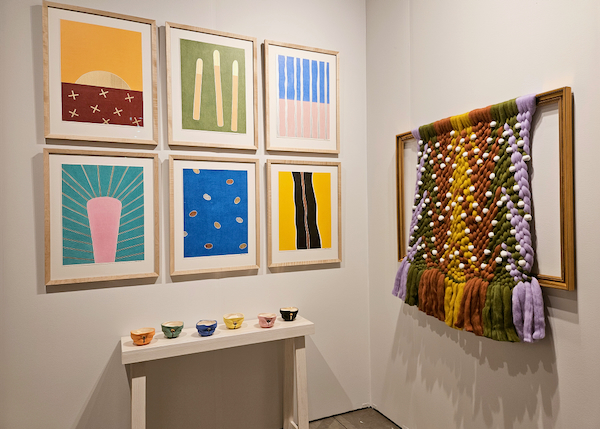
CNF showcases much beyond fine art: they have film and video art, sound installations, and poetry readings. “We are very contemporary people,” said Yepa-Pappan about how they are not focused on showing “traditional art,” or what the general public would expect indigenous artists to be making. “We need to have people understand that, as Native artists, we should be advancing. We should be evolving. We shouldn’t be stuck in timeframes of ‘we can only make art in this one particular way.’ So those are the kinds of messages that we’re trying to show,” said Yepa-Pappan.
Their future-gaze in their brightly lit storefront in Chicago’s loop allows connections to form with people who casually stumble onto the space. When I asked about one of their favorite memories, Yepa-Pappan reflected on a fortuitous moment. “A group of young people was visiting from Oklahoma,” said Yepa-Pappan. “And I said, ‘yeah, come in!’ and I noticed one of them left a comment in our comment book, and they said, ‘I felt instantly at home as soon as I walked in.’”
To learn about the Center for Native Futures, visit centerfornativefutures.org and connect on Instagram at @centernativefutures.
Contemporary Art, Contemporary People: The Center for Native Futures is published in Issue 41. Purchase a copy here.
Samuel Schwindt is always looking for the maddest spectacles and vampiest explosions. A word|object|surface-smith, he originates from an evangelical community and a contradictory motorcycle culture in Indiana (he left religion on highway 65 north to Chicago). Through his young-life he honed skills in wood and metal, and used his craft history to receive a BFA in Studio Art from the School of the Art Institute of Chicago and an MFA in Interdisciplinary Art from the University of Illinois at Chicago. Now, he works as a commission-based leather-gear crafter, archivist, sculptor, curator, freelance writer, and educator.