

Feature image: Akindele John. Photo: Genre: Urban Arts.
By Samantha Timm
My recent visits to the Walker’s Point Center for the Arts to see “Genre’d: Expressions of Blackness” and a conversation with Nakeysha Roberts Washington, curator of the exhibition and CEO of Genre: Urban Arts sparked my interest in the work of Nigeria-based artist Akindele John.
Struck by a tension in the pieces, I found myself lingering with Akindele’s work, then returning for a second and third visit. Upon further investigation, I was excited to learn that “Genre’d” is Akindele’s third exhibition in Milwaukee––with previous work in a solo exhibition at Woodland Pattern and a group show at 5 Points Art Gallery + Studios––and notice that the artistic legacy that he is developing in Milwaukee seems to run parallel to Nakeysha’s and the media platform she runs, Genre: Urban Arts.
The insights they’ve shared with me illuminate the impacts of creative collaboration on an individual and widespread community level. In this first part of a series of articles on these creatives, I focus on Akindele’s work; in the next part, I dive deeper into Nakeysha’s creative practice, Genre: Urban Arts, and the process of representing Akindele’s work to a U.S. audience.


Akindele John’s practice centers around “an ongoing exploration of the soul––mine and yours” that is “deeply rooted in…African-Nigerian heritage” and “pays particular homage to Black feminine identity and expression,” which he sees as “central to the pulse of African society…The grace, strength, and spiritual depth embodied by Black women” continues to drive his work. He notes, “conceptually, my practice is rooted in an ongoing engagement with African identity and diasporic memory,” and explains his mounting interest in “how the subject holds and presents history, interrogating the ways that hair, skin, adornment, and posture function as visual languages of inheritance, resilience, and transformation are part of the African and African Diasporic identities. The work becomes a space where past and present coexist as living, shifting entities.”
Akindele’s paintings start as “states of feeling” that “carry a kind of pressure that eventually demands form.” This urgency to create something from a “convergence of sensations and emotions” is the very crux of being an artist.

In spending time with his painting Dream Land, I’ve found that Akindele’s work offers neither an answer or resolution on his subject; instead, his work reads as discovery and invites contemplation, “charged” with both “serenity and regality.”
Dream Land––predicated on this moment of blissful sleep, its own expansive, imaginative space––particularly encourages introspection and presents a quiet, caught moment, with a female figure rendered in decisive brushstrokes that move effortlessly between figuration and abstraction. Set against vivid pinks and a deep- royal-periwinkle background, her dress becomes a focal point as it encases her in protective folds of pale and golden yellow softened by vast passages of ochre.
From her face––painted realistically in sharp focus––our eye moves down her sleeve as the brushtrokes become looser, traveling up the length of her arm to a grouping of purples, pinks, and reds that burst from her bouquet. The aliveness of the flowers she holds, bunchiness of the stylized pink blanket on which she rests, and her stylized halo that manages to catch a shadow cloak her in movement and prevent any sort of stillness from settling over her figure and her environment.
When viewers interact with his paintings, Akindele intends the work to “[unfold] new truths and meaning over time.”
This underscores his approach to creating spaces not only of contemplation, but also for rigorous engagement with culture, Blackness, physicality, and the unfixed experience of how we connect with each other.
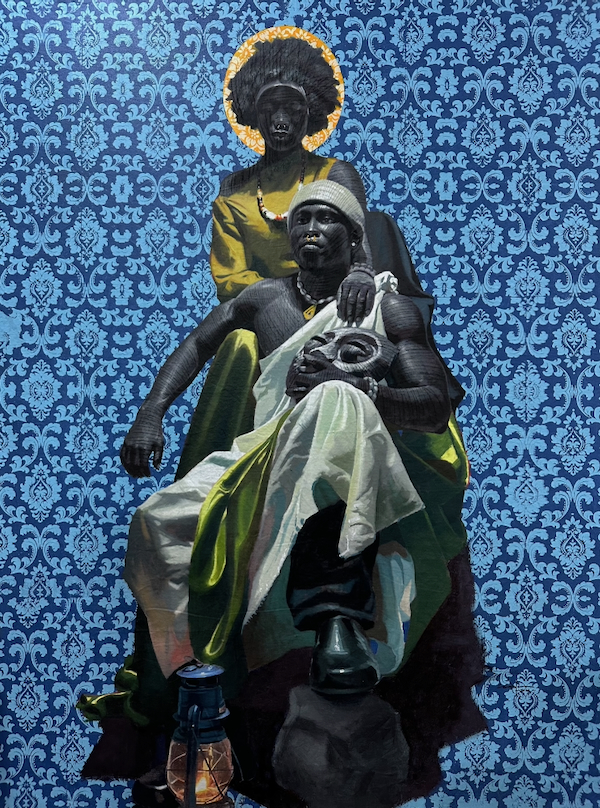

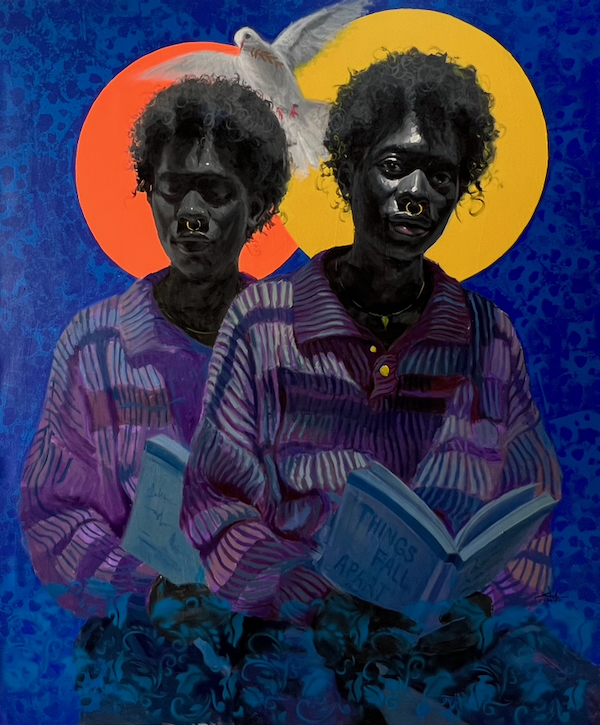
Akindele’s formal choices as a painter further acknowledge the complexity and depth of Black beauty: “I use a particular Black scale color for the human subject who I depict in my art…At first black as a color is an achromatic color, and a powerful tool for artists to create deep contrast, evoke emotions and historically represent power and elegance.”
He mentions using black to “relate it to my art as a Black African artist” and “a way to talk about my cultural identity as Black as well as the traditions and Black history, bringing back the old way looks into present, even in diaspora.” The appearance of the “Black scale color” on his canvases seem to open up far-reaching sites for memory, engagement, and cultural histories.
He hopes that viewers feel “a sense of intimacy with the figure,” and that “the work offers a moment of return, to oneself, to memory, to questions of identity and belonging.” For Akindele, if viewers step away from his work “with a lingering sense of contemplation, or even uncertainty that continues beyond the encounter with the painting, then the work has achieved its purpose.”
A fundamental part of Akindele’s artistic project is something many creatives can relate to: “I hope my work continues to open space for viewers to slow down and reflect—not only on what they see, but on what they feel and remember in the process of looking…If the work can hold that space, even briefly, then it has fulfilled something essential for me as an artist.”
Akindele’s paintings remain resonant and capacious, capable of opening up spaces for reflection and connection––just as Nakeysha’s work with Genre: Urban Arts offer opportunities for artists of diverse mediums.
To learn more about Akindele John, visit akindelejohn.com and connect on Instagram @akindelejohnn.
To learn more about Nakeysha Roberts Washington and Genre: Urban Arts, visit genreurbanarts.com and connect on Instagram @nakeysha.
A Moment of Return: Part 1 is published in Issue 41. Purchase a copy here.
Samantha Timm is a Milwaukee-based curator whose practice balances curating, community engagement, and art making. She is the Manager for Arts Programming at the University of Wisconsin–Milwaukee, where she oversees the Union Cinema and Union Art Gallery in collaboration with a team of amazing students.
In her work, Timm centers the artist and their process, and strives to create the best possible conditions for creative growth and connection. Timm draws on her experiences curating, teaching, and innovating at various museums and galleries, including Saint Kate–The Arts Hotel, the Milwaukee Artist Resource Network, York Art Gallery, and the Chazen Museum of Art, among others. She has juried contemporary art exhibitions across the state of Wisconsin and presented art-historical research at conferences nationally and internationally. Timm holds degrees in the History of Art from the University of York (MA) and the University of Wisconsin–Madison (BA).