

Feature image: John Himmelfarb. Photo: Rick Graves.
By Matthew Rose
In 2024, “How Things Stack Up,” The Koehnline Museum of Art in Des Plaines, Illinois, celebrated a 60-year survey of John Himmelfarb’s art. Bringing together the artist’s earliest and most recent works, Himmelfarb’s abstractions in paint, and the range of his sculpture in wood, steel, and bronze, to his REO Speed Wagon assemblages – drivable artworks were on full display.
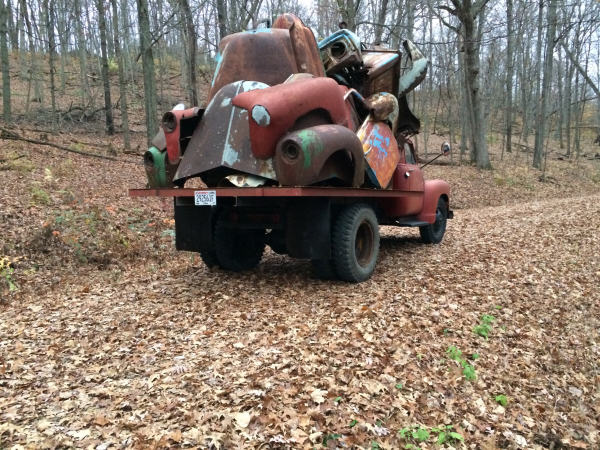
The trucks are gutted and sometimes repainted, their beds serving as plinths for rising temples of rust and iron plucked from junk yards. Himmelfarb’s incarnations lay bare a mid-century American dream, casting their glance into the future by amassing the past.
“Penelope Awaiting Her Chamberlain” (2013), his first, cost Himmelfarb $2,000, paid to a local farmer. The 1946 Chevrolet was stripped, then loaded with oil drums, pipes, and old bed frames. With a working engine and questionable brakes, “Penelope” found her way across the Midwest; others were featured in dada-like concerts, like the one at Café Coda in Madison. Musicians drummed on the fenders and searched for melodies along the scaffolding, a performance John Cage might have appreciated in its tonal discordance and harmonic consistency.

While Himmelfarb continues to paint out an America in motion, the artist’s language – complex, personal and layered – has found its way to airport terminals (Boston’s Logan), the Kedzie metro in Chicago, a school in Omaha. The trucks, however, take on weighty matters in ways two-dimensional works can’t. “Remains” (2015), now parked at Sculpture Fields in Chattanooga, says Himmelfarb, “is made up of body parts – truck body parts. The theme is death and what we carry with us.”
Motion and the open road have always attracted artists. The 20th century offered generations a seductive industrial prologue. Marcel Duchamp’s “Bicycle Wheel” (1913) notoriously signaled this new addiction. Painted cars appeared on the covers of Vogue and in sleek 1930s showrooms. After two world wars, the ‘70s opened up the pump for artists like Warhol and Lichtenstein, who painted the bodies of BMWs. John Chamberlain, an inspiration to Himmelfarb, turned crushed car bodies into exquisite and colorful pop. Charles Ray’s life-sized painted aluminum firetruck was stationed on Madison Avenue outside the Whitney’s 1993 Biennial.
Himmelfarb’s first truck works were modest paintings, drawings of pickups, chortling along roads through a made-up American landscape. He borrowed from Philip Guston’s thick impasto and black lines, giving his machines a heart and soul. The trucks grew up and took on a third dimension; some manifested in bronze, at first child-like, then in steel and wood – each new model swelling like teenagers learning how to impress.
Himmelfarb commutes from his studio in Chicago to his home-studio in Spring Green, Wisconsin, and is at work on a new piece. The truck is entirely fabricated in aluminum. A wooden model produced in 2025 anticipates a full-sized sculpture this year.
“I’m calling it ‘Andromache, Love and Grief,’” says Himmelfarb. “Andromache was the Greek goddess known for her virtue and fidelity – and the suffering of women.”
To learn about John Himmelfarb, visit johnhimmelfarb.com and connect on Instagram at @John Himmelfarb.
Drive Thru: John Himmelfarb is published in Issue 21. Purchase a copy here.
Matthew Rose is an artist and writer living and working in Paris, France. A graduate of Brown University in Linguistics, he has exhibited his collage works throughout Europe, the United States and Japan, notably “Weekend Plans” at the Karuizawa New Art Museum, Japan. His most recent exhibition was “Refuge” in Arles, France. He conceived and curated the global mail art project A Book About Death at the Emily Harvey Foundation Gallery (NYC/2009), with 30 installations of the works across the US, South America, Europe and Japan. He is the author of several books including Coronaville, Wait There’s More! (2024/Lulu), I’M MUCH BETTER THANK YOU (2026/Lulu), Natural Causes (2025/Lulu) and The Self Improvement Alphabet (Red Fox Press/2019). He has written for many newspapers and magazines, including The New York Times, The Wall Street Journal and his own magazine, Trouble, an occasional quarterly art review. His next book is “another day” due out in mid-2026. He regularly plays mandolin wherever he travels, but mostly in Paris.