

Feature image: Courtesy of Latinos Organizing for Understanding and Development (LOUD)
Opening reception: September 15, 5-8 pm
September 15 – October 15, 2026
The Gallery at Traux, Madison College
1701 Wright Street
Madison, WI 53704
By Dana Maya
Madison, WI – This week I had a chance to preview Las Curanderas: From Ashes, We Rise, a group exhibition of Wisconsin-based Latina and non-binary Latinx artists on view at Madison College from September 15 to October 15, 2026. The show is curated by Jessica M. Gutiérrez, a Nicaraguan-American watercolor and mixed media artist, and Issis Macias, a Los Angeles-born Mexican-American abstract painter, both residing in Madison. Las Curanderas brings together 40 works by 26 emerging and established artists working in a wide range of media. In the words of Gutiérrez and Macias, the exhibit “centers Latina artists as healers, truth-tellers, and agents of transformation in a time marked by political injustice, and violence against our communities.” The show was created in partnership with Latinos Organizing for Understanding and Development (LOUD), a statewide initiative supporting Latinx artists and fostering cultural connection throughout Wisconsin.
Featured artists are Nicole Acosta, Alanis, Sujhey Beisser, Angelica Contreras, Yesica Coria, Che Correa, Sara Isabel Donoso, Natalie Ergas, Xela García, Ariana Gutierrez, Ellia Ana Hill, Alexandra Torres Him, Vanesa Knutson, Samantha Lezama, Alanis, Mayra Linares, Reyli Cerda-Martinez, Juliet Maya, Paola Mayorga, Kanoe Montaño, Mizuleyka McCarthy, Carina Vargas-Nunez, Chele Ramos, Gabi Rivero, Linda Santiago, Angelica Valenciano, Sophia Voelker.
When I entered the gallery, I was struck by two works by Carina Vargas-Nuñez that employ large swaths of bold graphic color. Cycles shows two figures in front of an almost supernaturally blue sky and a large waxing crescent moon. The figures are submerged in the sea; their bodies overlap in transparent sections. Bright yellow butterflies alight on their hair and shoulders. One figure faces forward, eyes closed, mask-like, with a caterpillar for a nose; the other, in profile, gazes at the first. Both faces are constructed from smaller organic and inorganic shapes. There is an additional “couple” in the painting: a pair of hands whose curved fingers almost touch. The figure on the right reaches out delicately to touch a hand that appears, disembodied, at the edge of the frame. On each hand, a delicate caterpillar crawls like an extra digit with its own intelligence. This charged rendering of two hands echoes the iconic depiction of near-contact between god and man in Michelangelo’s Creation of Adam in the Sistine Chapel. While the gap signals that similar energy of yearning, in this case, the symmetry of hands communicates a reciprocal divine, and the presence of the caterpillar pair evokes a larger world of creaturely consciousness.

Outstretched, almost-touching hands recur in Reflections, Vargas Nuñez’s second piece. Again, two figures reach toward one another; their pose is delicate and an organic relationship is established between them and two orange butterflies. In this painting, the almost-touching hands are framed by an orange-red sun, which acts as the third figure of the work’s triad: the orb’s presence throws the human postures into relief–and into relation.

Overall, I am struck by the depiction of intimate human relationships in collaboration with an animistic world from which they are indivisible. This is my first taste of what medicine might be in store in Las Curanderas.
* * *
Group exhibits of Latina and Latinx non-binary artists are still rare in the art world, and more so in our region. But the Madison College Gallery has become a venue that fills critical gaps in the Wisconsin art scene: in the last two years, the college has hosted numerous group shows dedicated to underrepresented artists. These include SOULful Joy, an exhibit on resilience and Black joy; Indigenous Wisconsin: A Story of Resistance, a mixed-media show of 24 Indigenous artists across the state and the 12 Tribal Nations; and First-Gen Journey, a collection of works by first-generation college students, faculty, and alumni. It is fitting that the technical college, an institution that attempts to redress–and yes, heal–the harms of exclusionary education would house this show about community care. Las Curanderas is the first group exhibition of Wisconsin-based women and non-binary artists with ancestral roots in Latin America. The works are made with a wide array of media–paint, graphite, beading, photography, corn husks, collage, fabric, and food.
Las Curanderas (a word for folk healer or medicine woman in Latin America and the Caribbean) was inspired by the Mexican singer Natalia LaFourcade’s song “María la Curandera,” itself based on a poem by María Sabina, a Mazatec healer and poet who is famed for having conducted healing ceremonies called veladas. The song names numerous herbs used for traditional healing–menta, lavanda, romero, eucalipto–as well as the elemental forces of wind, water, and fire. The final lyrics speak of fuego (fire) and flores and ask que se vuelvan polvo todos los dolores (may all pains turn to dust).

May all pains turn to dust indeed. At this time of extreme dehumanization and state violence, when human beings are being abducted, imprisoned, beaten, and killed, some within sight and far more out of sight, we need resistance of many kinds. I hope that the works in Las Curanderas might provoke healing in the tissues of our collective body. May all pains turn to dust.

It’s critical to understand the works in Las Curanderas as part of a diverse and not monolithic culture. “Latinidad” is an inherited concept from the colonial experience of mixing, but each nation has its own unique experience of that colonial mélange. Different Indigenous and African ancestries, legacies of plantation slavery, unique experiences of European conquest and migration, and distinct geographies have formed the artists in Las Curanderas. The pieces in the show are nonetheless marked by a shared and recognizable cultural vocabulary: indigenous plants and animals, hands, braids, food, [grand]mothers, women’s bodies, the corazon sagrado (sacred heart) and other religious icons.
Perhaps unsurprisingly in a show about curing, hands appear everywhere in Las Curanderas–I found hands in prayer, clasped hands, hands cooking and braiding and farming, hands holding cempazuchitl (marigold flowers) or herbs, or fruits, or a pregnancy test. Grandmother hands, mother hands, and baby hands. Sometimes, the presence of hands is not shown but implied: in two photos of dishes by Sujhey Beisser–Lo Que No Se Quema (Empanadas: De Cazón a Halibut)[2020] and Chivo en Coco (De cenizas, Nuevos Sabores) [2022]–her photographing-but-unphotographed hands have cut, wrapped, smashed, and rolled to make the empanadas, salsa, plantains, rice, meat, and fish represented. And an arresting mixed-media piece by the artist Arianna Gutierrez titled Dear Miss India Maria (2024) depicts a thick, shiny braid of hair that has been cut by an unseen hand. On a piece of plywood, the words “I’m so sorry/I sacrificed parts of myself and the ribbons in your hair/tying myself into knots to be something I’m not/I hope you can forgive me/like how I’m learning to forgive myself” are rendered in an ornate black script reminiscent of the style of traditional Chicanx tattooing. The invisible hand of assimilation has cut off the subject from her culture. But the uprooted braid, memorialized in the painting, becomes a rope that can tie the speaker to her people.

If I could give an assignment to visitors interacting with the show, I would ask them to mime each gesture with their own hands. It is hard not to feel the tenderness and honor in the intimate portrayal of human hands, and hard not to be returned to your own hands, helpers that they are.
***
The more time I spent with the works in Las Curanderas, the more their medicine worked on me. I descend from a line of single Mexican mothers and I write poetry and essays about my own matrilineage. So of course I was moved by the homage to the powerful relationships between women–mothers, grandmothers, sisters, and lovers.

For instance, Mizuleyka McCarthy’s McCarthy Girls (2025) renders matrilineage in an affecting way; she uses multiple exposures of pictures of women family members to express the interrelation and cyclicality of generations.
As I walked the gallery, I found the plants, fruits, flowers, birds, and animals insisting that they were the other subversive subjects of Las Curanderas. These living beings recur across disparate works: cempazuchitl flower in Las Manos de mi Abuela by Knutson (2026) and De Un Campo de Espinas by Cerda Martinez (2026); corn in Choclo Dorado by Donoso (2020), Monumental Catrina by Coria (2026), and many other pieces; and blooms, hummingbirds, butterflies, and cactus sprouting up or alighting everywhere. You might even regard various works as “group portraits,” capturing humans, plants, and animals in their interdependence. Whatever one would say about the loving renderings of flora and fauna in the show, I felt the resilience of a living world that persists despite human violence and offers us a receta(prescription/recipe) for resistance and repair. The plants, rivers, planets, and other natural phenomena in Las Curanderashave palpable energy, agency, and spirit.

There is a lyric in “María La Curandera”–Cúrate, mi niña. . . y recuerda siempre que tú eres la medicina. (Cure yourself, my daughter, and remember that you are the medicine)–that Samantha Lezama incorporates directly into her print María (2026). The piece depicts an elderly woman with a luminous crown of sunrays, offering a flower in one palm and surrounded by herbs as well as a medicine bottle spilling pills and the words of the lyric. This imperative–CÚRATE–to understand the self as both the one who administers medicine and the medicine itself, has a powerful way of remaking agency–we are invited into a view of ourselves not as actors who use plants and elements of nature but as the curative elements ourselves.
I appreciated that the artists’ renderings of healing in Las Curanderas was not sentimental. These are not decorative works for easy consumption. A romanticized view of Latina culture might imagine our heritage as non-threatening, all sweet grandmothers and pretty flowers. But this is a fierce flowering. The pieces engage with both socio–historical and personal wounds. Viewers will feel the sting of history–of exile and war and family separation. There are pieces depicting warplanes, guns, calaveras, barbed wire, tunnels, thorns, and knives. The artists’ statements speak of various forms of personal pain–addiction, mental illness, disability, and mourning–core human experiences. But this authentic engagement with hurt only serves to underscore that our pain is indivisible from our power. Medicine burns in order to heal. We know how to repair.
I came away from the show changed. I thought of my own abuelita, who was a teacher and used her own hands for crocheting gorgeous bedspreads in sherbet colors, for cooking fried plantains in fat, and sometimes, for holding protest signs. She was never called a curandera, but she made aguardiente de hierbas (herb firewater) which she used to heal us from every kind of ailment. I left Las Curanderas and immediately phoned my 85-year-old mom to ask for the receta to make aguardiente de hierbas. She listed off the many herbs and the method for making it, which included placing the jarred herbs under moonlight to receive “el sereno” (the night dew). We vowed we would gather the herbs in the mercadoin March, the month in which it must be prepared, and make our family medicine.
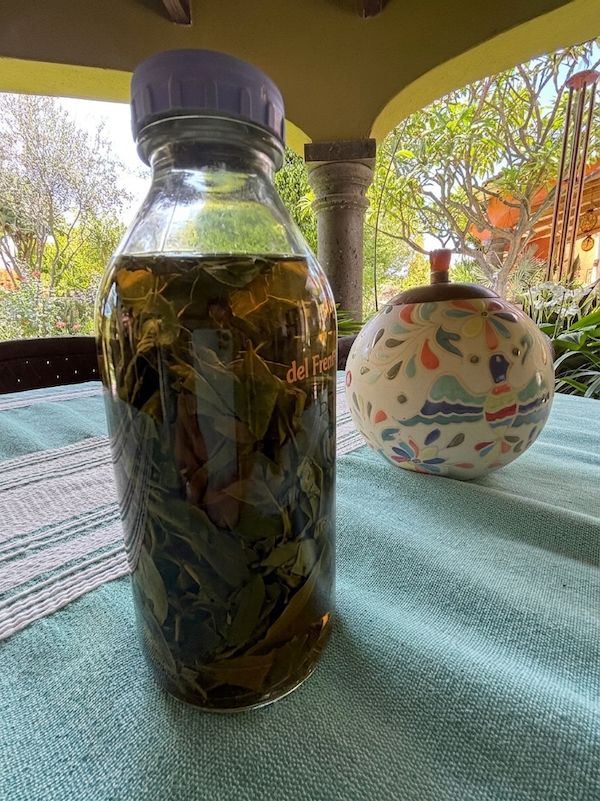
For now, I give you this prescription: first, see the show. Then, answer this question: how have women healed you across your lifetime? What has ailed you, and what has cured you?
Dana Maya is from the Mexican diaspora, descending from a line of single mothers. A poet, essayist, multimedia collaborator, and educator, she has created with painters, animators, video artists, students, and community organizations for over 30 years. Her work appears in collections including Migrations and Home: Elements of Place, Basta:100+Latinas Against Gender Violence, Listen to Your Mother, A Line Meant as well as in journals, museums, memorials, and other public sites. She is founder of the visual poetics project POEMA [] PINTURA, has been a poet with Writing the Land since 2023, and was the 2025 DANE Arts/Starting Block Artist in Residence.
Instagram: @danamaya.poeta