

Feature image: Studio Shot, 2024. Photo: Tommy Martino.
By Linda Marcus
Disgust and discomfort are precisely the reactions Emily Mulvaney hopes to evoke in viewers of her art. “I like it,” she says. “I knew leaning into abject imagery and textures would allow me to play with that sense of the unknown. I’m more offended when there’s no reaction at all.”
The Minneapolis-based artist creates amorphous sculptures inspired by microbes, bacteria, and magnified cellular forms. Her practice exists at the intersection of art and science, transforming biological research into deeply personal sculptural investigations. Mulvaney describes the work as an attempt to better understand her own body and its invisible ecosystems: “I was interested in the other creatures and beings using my body as their home, and in unfolding a conversation about multispecies assemblages.” The work recalls the legacy of abject art explored by artists such as Kiki Smith and Louise Bourgeois, both of whom used the body as a site of vulnerability, transformation, and psychological inquiry. Mulvaney pushes this further. Her practice aligns with more recent bio-art traditions in which scientific processes become both medium and metaphor.
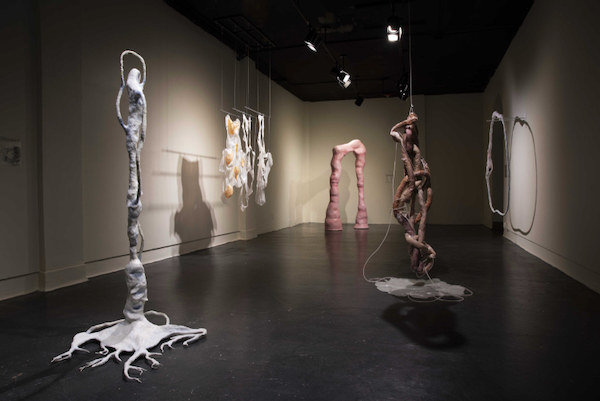
Mulvaney began developing her work while attending graduate school at the University of Montana. She divided her time between the studio and the laboratory, collaborating with scientists and gaining access to specialized equipment. Using bacteria collected from her own body, she cultivated living specimens under laboratory supervision. The experience fundamentally altered her understanding of herself. “It was the first time I witnessed my physical self as a specimen,” she explains. “It dismantled a lot of societal pressures women place on themselves. Seeing myself simply as a physical being trying to stay alive took some of that pressure away.”
In one project, Mulvaney created sealed environments that allowed bacteria to grow and communicate, their interactions revealed through shifts in color and form. In another, bioplastics became substrates for mold gathered from her art studio. These works position decay, contamination, and transformation not as something to fear, but as evidence of interconnected systems in constant flux. Her sculptures echo the material experimentation of artists working with organic processes and entropy, while also invoking philosopher Julia Kristeva’s concept of “the abject” — that which unsettles boundaries between self and other, attraction and repulsion.

2025
Chromobacterium violaceum bacteria,
nutrient agar, chiffon, plexiglass,
vacuum sealed bag, steel pipe,
steel cable, hardware
3 x 4 ft.
Image Credit: Merry Sun

2025
Chromobacterium violaceum bacteria,
nutrient agar, chiffon, plexiglass,
vacuum sealed bag, steel pipe,
steel cable, hardware
3 x 4 ft.
Image Credit: Merry Sun
In addition, Mulvaney is interested in the tools used in the lab. “Shifting toward the instruments, technology, and architecture of scientific objects is interesting. I want to reimagine them, abstract them, or shift their origin. I’m curious how that might open things up even further.”
Despite the unsettling nature of the work, humor remains central to Mulvaney’s practice. “Humor and absurdity can bring down barriers,” she says, particularly within the often-inaccessible language of science. “Lab spaces can feel intimidating with all the jargon. Humor adds a sense of humanness back into it and makes it more approachable.” That balance between unease and play gives Mulvaney’s work its particular power: the sculptures repel and attract simultaneously, asking viewers to confront the strange biological realities that exist both within and around them.

To learn more about Emily Mulvaney, visit emilymulvaney.com and connect on Instagram at @emily_mulvaney.
Emily Mulvaney: Intersection Between Art and Science is published in Issue 41. Purchase a copy here.
Linda Marcus is a multidisciplinary artist living and working in Milwaukee, Wisconsin. Drawing on her long history as a TV News journalist and fashion designer, her work in fiber and sculpture touches on issues of memory, identity, and materiality.
Marcus was recently awarded an art residency at the Massachusetts Museum of Contemporary Art, and her work has been exhibited at the Museum of Wisconsin Art, the Wisconsin Museum of Quilts and Fiber Arts as well as the Charles Allis Museum and numerous galleries across the country and in art publications. Currently, Marcus is the creative director and co-curator for the Saint Kate Arts Hotel in Milwaukee.